The 10 Best Alternate Universes In Sci-Fi
Whether they’re created by time travel or simply by the possibilities presented by the roll of a dice, some of the best moments in science fiction have happened while hopping between parallel worlds. Sometimes alternate dimensions are a place of unspeakable evil, other times they’re a perfect example of what might have happened had we gotten it right the first time. These are the ten best alternate dimensions in science fiction.
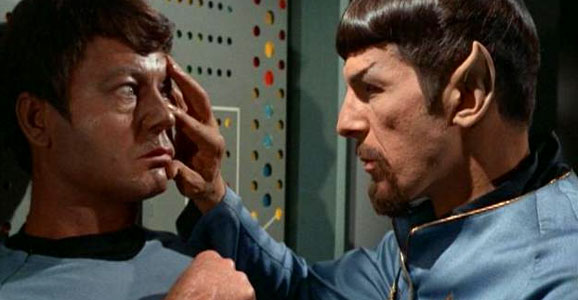
The Mirror Universe as seen in the Star Trek episode “Mirror, Mirror”
Star Trek’s “Mirror, Mirror” universe episode made such an indelible mark on our culture when it debuted in 1967 that it’s still the default way of explaining alternate dimensions, in just about any context. Like all the best original Trek episodes, it still holds up.
It revolves around a transporter accident which sends Captain Kirk, Dr. McCoy, Scotty, and Uhura to a nearly identical, yet fundamentally different universe. There the Enterprise is the tool of an organization called The Empire, which uses it to murder and threaten anyone who opposes it. They must attempt to blend in with a crew full of bloodthirsty killers, including an evil, goatee wearing Spock, while looking for a way to get back to their own universe without actually having to commit genocide. Other Star Trek series went on to visit the Mirror Universe, but none of them ever did it as well as they did it the first time. Remember to put on a goatee the next time you want to do something evil, then blame it all on your Mirror Universe counterpart if you get caught.
![]()

The Darkest Timeline as seen in the Community episode “Remedial Chaos Theory”
“Remedial Chaos Theory” is one of Community‘s most brilliant of episodes, but it’s The Darkest Timeline that’s so incredible. The dice rolls one, and the chaos ensues. In this version of the party at Troy and Abed’s Troy has to get the pizza fast to make sure he misses nothing, Pierce gets shot, Britta sets the room on fire, and Troy returns to find everything out of control and the Norwegian troll staring at him. It’s just a few minutes of basically the worst things that could possibly happen actually occurring to the study group.
The Darkest Timeline is hilarious, but it’s the tag at the end of the episode that seals the alternate reality as legendary. Religious Shirley is now a devout alcoholic, Jeff is a one armed man, Troy burned his throat battling the troll, Pierce is dead, Annie is nuts, and Britta has a bad dye job. The episode ends with Abed going full evil and breaking out sweet felt goatees. He puts one on, and leaves everyone on the edge as Community goes on hiatus. That’s the darkest of timelines.
![]()

The World Where Donnie Darko Lives as seen in Donnie Darko
“Every living creature dies alone.” That’s the warning Donnie receives from Grandma Death, and it’s the fate he avoids at the beginning of the movie when he leaves his bed just before a jet engine crashes through his bedroom roof. Guided by visions of his creepy, hell-bunny spirit guide Frank, Donnie falls in love, commits crimes, exposes a pedophile, and tries to figure out why the world will end in 28 days, 6 hours, 42 minutes, and 12 seconds. In the end, every one of the film’s characters is affected by Donnie, and then he returns to the inciting moment at the beginning of the film and chooses to stay in his bed and meet his death.
Is it to put reality back in balance and save the universe? Is it to prevent the death of his once and future girlfriend, Gretchen? It could be one, or the other, or both, or neither. That’s the beauty of Donnie Darko, that it lends itself to a thousand different interpretations. Writer/director Richard Kelly provides tons of murky mythology involving the mechanics of time travel on the DVD, but the questions raised by the original film are a lot more compelling than any of the concrete answers provided. And you just can’t beat that closing montage, set to Gary Jules’ cover of “Mad World.”
![]()

The Universe Where Enterprise-C Survives as seen in the Star Trek: The Next Generation’s episode “Yesterday’s Enterprise”
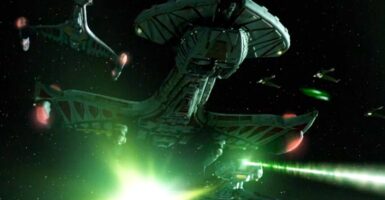
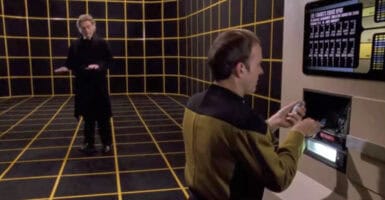
In what most agree is one of the show’s best episodes, the starship Enterprise encounters a rift in space-time and, when a ship begins to emerge from the vortex, suddenly time is irrevocably altered, creating an alternate universe. There, suddenly the Enterprise is no longer a ship of exploration, but a ship of war involved in a conflict that the Federation is on the verge of losing. The crew remains utterly unaware that history, and they along with it, have been fundamentally changed. It’s only when Guinan begins to wonder why Tasha Yar, who died on an alien planet years ago, is suddenly standing on their bridge that Picard and his crew begin to suspect something has gone horribly wrong.
The ship spotted coming out of the vortex is the Enterprise-D’s predecessor, the Enterprise –C (piloted by Happy Gilmore’s Shooter McGavin, no less!). The Enterprise-C’s fate was to go down fighting a hopeless battle defending a Klingon outpost but by surviving to escape through time, history was altered, leaving Earth in the middle of a losing war with the Klingon Empire. Picard must decide between sending the Enterprise-C and her crew back in time to face a certain death and fighting a battle to save the Federation which he cannot win. The episode ends with the alternate universe’s more battle-hardened, defiant Picard fighting on a bridge in flames, as part of a doomed bid to delay superior forces long enough for the Enterprise-C to return though the rift and set things right with her crew’s death.
![]()

The Wish Reality as seen in the Buffy the Vampire Slayer episode “The Wish”
When Cordelia Chase, after having been impaled and cheated on by Xander, comes back to school she gets it in her head that Buffy is to blame for all her problems. It’s a high school mindset kind of thing, but there’s an element of sympathy you feel for her as she makes a nonchalant wish to the new girl in school. This new girl turns out to be a vengeance demon who grants Cordelia’s wish that Buffy Summers had never come to Sunnydale. The result is an alternate version of the town where Giles and Oz race around as the “White Hats” trying to fight back against demons and vampires, the Master from season 1 was victorious in his endeavors and now rules the area, and Xander and Willow have been turned into blood suckers.
It’s not just that Buffy is gone, but that she’s now back as the queen of the school that delights Cordelia. This alternate world reveals not only the importance of Buffy to Sunnydale, as she’s obviously kept a lot of evil at bay, but also that Cordy’s inclusion in the Scooby Gang has changed her. But by far the greatest thing about an alternate version of Sunnydale is that Willow is the most badass vampire vixen to ever exist. It made Willow sexy, and that’s something we can all get behind.
![]()

Walternate’s World as seen on Fringe
Fringe is all about the alternate reality, it’s an integral part of the series. We’re slowly introduced to the parallel universe until finally it’s revealed that Walter Bishop broke through in order to steal the other version of his son, who died in “our” reality. It’s the classic sci-fi version of an alternate dimension in that it’s slightly different, but a lot is the same. The most interesting part of the alternate is “Walternate,” the other Walter Bishop. Our Walter is a genius, but because of some deliberate brain trauma he is a bit addled. It’s an endearing trait, but we see why Walter would want to curb his natural proclivities with the revelation of Walternate being so power hungry and sometimes evil.
Although evil is relative, because the things that those in the alternate universe do is to protect their world. It’s the interconnection and constant movement from each reality that makes Fringe so great at this common sci-fi trope. The two worlds ended up having to work together, giving the show a dual reality that’s a joy to watch. It almost never gets confusing, and that alone is a huge achievement.
![]()

Hell Valley as seen in Back to the Future Part II
When Doc Brown picks up Marty and takes him for a jaunt into the future world of 2015 to save his kids, it seems like it’s going to be all fun with hoverboards and flying cars, at least until old Biff steals the DeLorean and uses it to go back to 1955 make his younger self rich. When Marty goes home to 1985 expecting to see good, old Hill Valley, he instead finds himself in a nightmare world where Biff Tannen killed his father, married his mother, and rules the town with an iron fist.
Dubbed “Hell Valley” by the graffiti artists who live there, Hell Valley is an alternate dimension created by Old Biff’s perversion of the timeline. To set things right Marty will have to revisit 1955 and stop Biff all over again, but not before he spends time staring at his Mom’s outlandish boob job and being beat up by Tannen thugs in the new nightmare world Biff’s greed has created. Back to the Future II is often overlooked as the lesser of the trilogy, but the film takes things right to the edge with Hell Valley, a place which might not be so bad… assuming your last name is Tannen.
![]()

Youth World as seen in Sliders’ episode “The Young and the Relentless”
Sliders was the only television show ever based entirely on the multiverse theory. Their best moments happen in the season two episode “The Young and the Relentless”, our interdimensional travelers find themselves in a world run by the under-30 set. Pundits and the media often bemoan “apathetic youths”, but “The Young and the Relentless” forces us to ask what the world might be like if the young were to realize the power of their numbers.
In this world, the danger of the Social Security system bankrupting the government and a job market glutted by baby boomers turned riots not unlike the European student uprisings of recent years into cohesive, powerful movements. Since the young took charge, environmental reform and stewardship have made actual progress and young people are actively involved in politics and economics. Unfortunately, they’ve also enacted mandatory retirement ages and other discriminatory laws and let the (corporate sponsored) public education system get even more sharply divided along ecumenic lines. At its core, the Young and the Relentless universe is a warning to the establishment in our world. Watch it, or there’s no telling how you’ll be treated should the tables ever turn.
![]()

The Universe Where Christianity Never Existed as seen in Family Guy’s “Road to the Multiverse” episode
Family Guy has tackled alternate dimensions several times, but never better than in Road to the Multiverse. When Stewie uses a remote control to send he and Brian hopping through parallel worlds Sliders style, they end up hopping through all sorts of different realities. Among the places they visit are a Flintstones universe, a Disney universe, a Japanese universe, a dimension where everyone needs to poop at the same time, universe inhabited only by a guy in the distance who gives out compliments and several other universes in a vain effort to get home, and the one where dogs are the masters and people are the dogs. But the one that tops them all is the universe where Christianity never existed.
In the universe where Christianity never existed, the Dark Ages never happened, thus scientific advances were made without interference. The result is a sort of Utopia, a place that’s so great even Meg is totally attractive. Covering this ground is a controversial stance to take, but it’s nothing less than fans have come to expect from Family Guy. Whether or not you agree with their extrapolation, that the world would be a better place without Jesus in the way, you’ve got to admit that this universe, more than any other alternate dimension ever imagined, definitely seems like the best one to live in. At least the streets are clean, and if the people of this world can make Meg hot, just imagine what else they can do.
![]()

The Universe Without George Kirk as seen in Star Trek (2009)
Star Trek was in trouble. Enterprise went out with a whimper and, for the first time in decades, there weren’t any new Star Trek episodes airing. Trek needed a transfusion — of fresh vision, of excitement, of vitality. Enter J.J. Abrams and screenwriters Roberto Orci and Alex Kurtzman. They took the ballsy course of rebooting a property with some of the most die-hard fans around, gambling that they could make a Trek movie not just for fans, but for people who had never cared about Star Trek. By dropping a pissed-off rogue Romulan back in time, they created an entirely new, alternate Trek timeline where Jim Kirk grew up without a father and where nothing can be taken for granted.
They put that mission statement front and center by destroying Vulcan, setting us up for a very different Trek universe in the future films. Best of all, by using Leonard Nimoy’s “Spock Prime” as a transition point between the two realities, they made it clear that the original timeline beloved by generations of fans is still just as valid as this new one. That allowed them to pacify rabid Trekkers while providing a new Trek playground, one where anything can happen. Trek 2 will determine how well Abrams and company make use of that freedom, but for the first time in a long time we don’t know where Trek is headed… and that’s a good thing.
Loading ...